

Connection charge reconciliations
The Electricity Authority (EA) has introduced new rules to improve transparency, fairness and consistency in electricity connection pricing across Aotearoa.
These changes support efficient electrification and long-term fairness between new and existing customers.
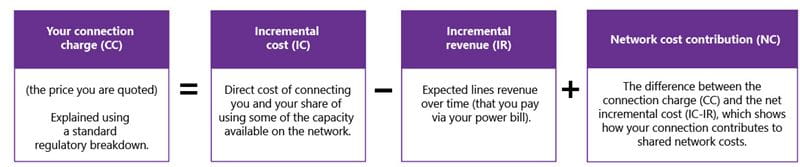
As part of these changes, we must prepare a standardised breakdown of connection charges into:
- Incremental costs (the direct cost of connecting you and your share of using some of the capacity available on the network)
- Network cost contribution (your portion of the cost of using the shared network)
- Incremental revenue (expected lines revenue over time - that you pay via your power bill)
This is called a ‘connection charge reconciliation.’
The reconciliation outcome shows how the connection charge compares to long-term costs and revenue using a consistent format across the motu.
Note: This is mainly a disclosure requirement. It does not automatically change how we set prices. It standardises how charges are explained and increases comparability.
Connection charge reconciliation example
This example of a connection charge reconciliation is for a new residential connection in an urban area of our Tauranga price region that qualifies for standard pricing.
What this means for you
- Connection charge reconciliations are available for jobs submitted to us from 1 April 2026.
- You can request a reconciliation showing how your connection charge is allocated - this is detailed and complex. It summarises costs, revenue and network capacity components using a standardised format and terms.
- The reconciliation is primarily to give our regulator, the Electricity Authority, visibility of how connection charges vary from the average around the country - it doesn’t change your quote or create a new charge.
- It may group costs differently from your quote, because it follows a standard format set by the Electricity Authority.
- The new rules allow prices to reflect local network conditions.
Find out more here.
Network ready and standard connection charge reconciliations
If your connection uses standard pricing (for example, a flat charge for a typical residential connection), we will provide a standard reconciliation for a standard connection instead of a bespoke one. This is permitted under the Electricity Authority’s rules and reflects the average costs and revenue for that class of connection. It ensures transparency while avoiding unnecessary modelling for routine connections.
- If you have applied for more than one standard connection of the same size (for example a four-lot subdivision) you can download one connection charge reconciliation report as this will be the same for each connection.
- If your work is a combination of network ready and standard connections, or multiple standard connections of different have different sizes please enter the details of each connection to download a connection charge reconciliation report for each connection.
- If you need help downloading your standard connection charge reconciliations, please reply to one of the emails we have sent you or contact us.
Request a standard pricing connection charge reconciliation
REQUEST A RECONCILATION
How to request a reconciliation that does not have standard pricing
For non-standard reconciliations, please respond to one of the connection process emails you've received and request a reconciliation. Connection charge reconciliations are available for jobs submitted to us from 1 April 2026.
FAQs
The new rules do not automatically increase or decrease charges for new connections. They change how charges are structured and explained. See more about pricing here.
The connection charge reconciliation is detailed and complex as it summarises costs, revenue and network capacity components using standardised language. This reflects the standardised format and terminology required under new regulation from the Electricity Authority. If you would like help understanding it, please read more here, or get in touch with us.
Your quote is designed to explain the physical work and project costs of your connection or modification.
The reconciliation follows a regulatory format required by the Electricity Authority. It groups costs differently to allow consistent comparison across all lines companies and all connections. Find out more about our pricing here.
Network capacity is the ability of the wider network (lines, transformers, substations) to carry electricity.
When you connect, you use some of that shared capacity. The new rules allow us to show how we allocate a share of capacity costs in a more consistent and predictable way.
An NPV calculation estimates the value today of money that you expect to be received in the future and what you think interest rates will be. In simple terms:
- When you connect, you will also pay ongoing network charges over time (as part of your power bill).
- The reconciliation compares the upfront charge with the expected future revenue from your connection.
- Like a loan where you have to pay interest as well as repaying the loan amount, future money is worth less than money today, it is adjusted to a 'today value’ (or ‘net present value’).
This helps assess whether new connections are paying their ‘fair share’ overall.
You do not need to calculate this yourself – it’s part of the regulatory disclosure.
Find out more information on the disclosure within the connection charge reconciliation here.
The rules aim to reduce unfair cross-subsidies over time. However, lines companies are shared systems. Costs are spread across many users within communities, and complete separation is not always practical or efficient.
The new rules are designed to make these cost allocations more transparent.
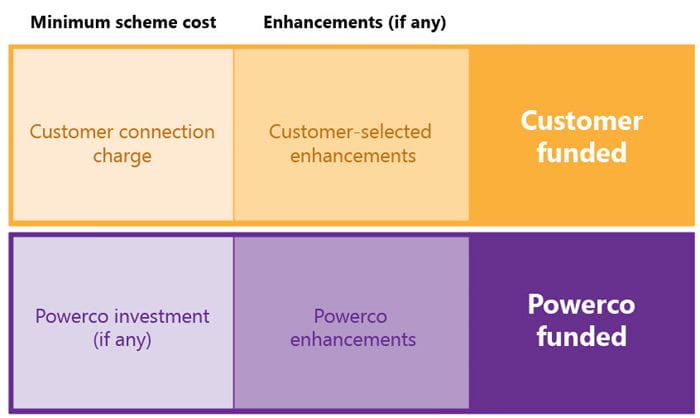
No. The minimum scheme must still meet technical and safety standards. It simply ensures you are not charged for enhancements you may not need.
You can choose higher specifications if you wish, at your cost.
Find out more here.
If you are the first person to fund a network extension, later users who benefit from that extension may contribute to you through a formal arrangement called a pioneer scheme. This makes the connection process fairer over time. Find out more here: link to pioneer scheme page on our website.
A connection charge for a new or upgraded connection is made up of a combination of components. We base your connection price on the lowest-cost, technically acceptable solution (minimum scheme). See how this works for a typical connection project (new or upgrade). If you want a higher-spec solution (for example, extra redundancy or future-proofing), you can request it - but you may pay extra. You will not be charged for upgrades or enhancements you didn’t ask for.
You can get a reconciliation for jobs with standard pricing above. Due to the high demand for our new connection service, we’re currently processing jobs which were received by us several weeks prior to 1 April. We will not supply connection charge reconciliations for jobs that have non-standard pricing until qualifying jobs (those submitted after 1 April) are being quoted.